Jun 4, 2025
SAVE
Present Summary
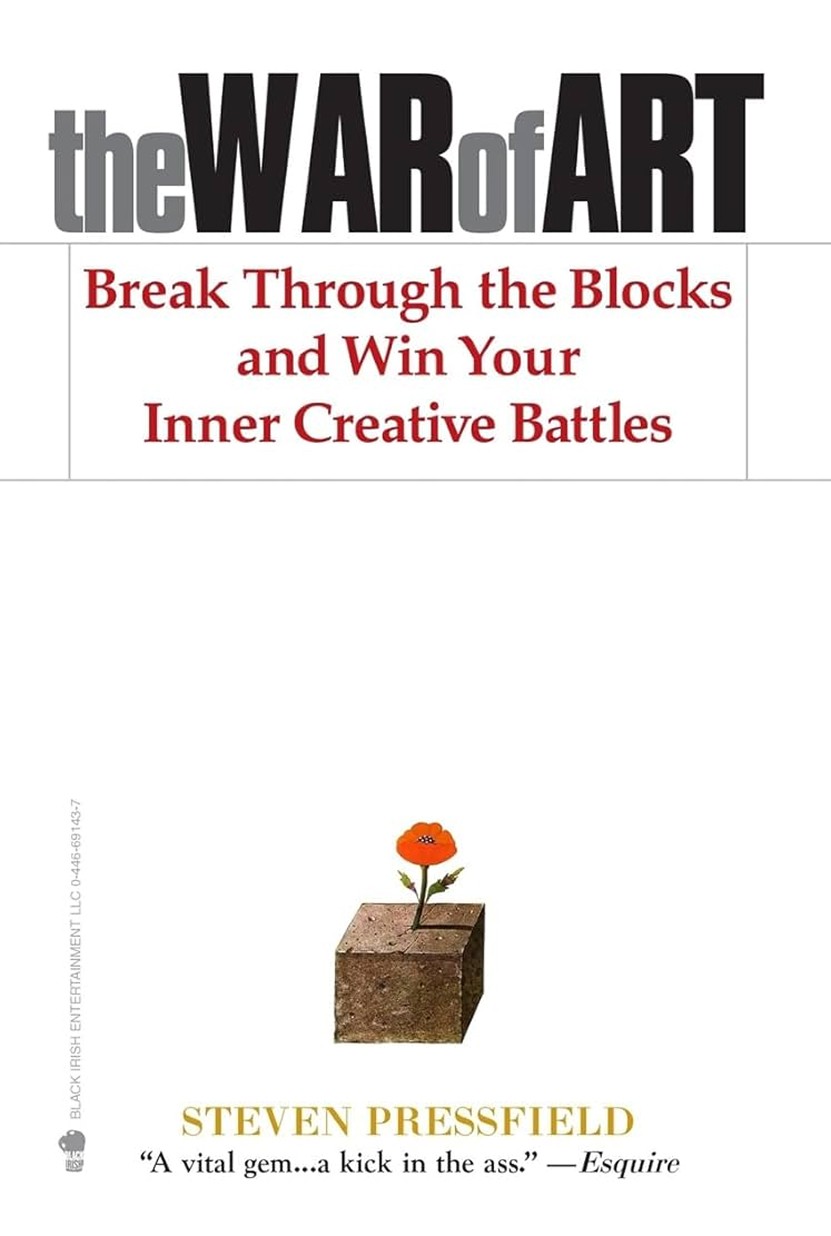
The War of Art
PRESENT Score: 94%
The War of Art by Steven Pressfield is the one book I probably gifted most in the last ten years, because it is one of the most important ones for me…
The War of Art: Break Through the Blocks and Win Your Inner Creative Battles by Steven Pressfield is an insanely effective and powerful guide to overcoming the internal obstacles that prevent individuals from realizing their creative potential. The book delves into the concept of “Resistance,” the invisible force that sabotages our creative efforts, and offers practical strategies to conquer it.
Pressfield’s insights are drawn from his own experiences as a writer, providing readers with a candid and motivational roadmap to overcoming self-doubt, procrastination, and other forms of Resistance. The War of Art is structured into three distinct sections: “Resistance: Defining the Enemy,” “Combating Resistance: Turning Pro,” and “Beyond Resistance: Higher Realm.”
This is one of the most important books I have ever read. I first read it when I was a student in 2009 and have reread and gifted this book many times since then.
Key Points
Understanding Resistance: Pressfield defines Resistance as a universal force that opposes creative endeavors. It manifests as procrastination, fear, self-doubt, and rationalization. Recognizing Resistance is the first step to overcoming it.
The Life of a Professional: To combat Resistance, Pressfield advocates adopting a professional mindset. This involves showing up every day, working through challenges, and committing to the creative process regardless of external validation or internal struggles.
The Role of Discipline: Consistency and discipline are crucial in overcoming Resistance. Pressfield emphasizes the importance of setting a routine, establishing habits, and treating creative work with the same seriousness as any other profession.
Embracing the Muse: The book suggests that creative inspiration, or the “Muse,” rewards those who put in the effort. By showing up and doing the work, artists can tap into a higher realm of creativity and achieve their true potential.
Practical Strategies: Pressfield offers practical advice for overcoming Resistance, such as breaking work into small, manageable tasks, setting clear goals, and creating a supportive environment that fosters creativity.
Higher Purpose: Beyond mere productivity, Pressfield explores the idea that creative work has a higher purpose. Engaging in art and creativity is not just about personal success, but about contributing to something greater and fulfilling one’s true calling.
Passages I highlighted in my book:
There’s a secret that real writers know that wannabe writers don’t, and the secret is this: It’s not the writing part that’s hard. What’s hard is sitting down to write. What keeps us from sitting down is Resistance. (Location 92)
Most of us have two lives. The life we live, and the unlived life within us. Between the two stands Resistance. (Location 95)
Resistance is the most toxic force on the planet. It is the root of more unhappiness than poverty, disease, and erectile dysfunction. To yield to Resistance deforms our spirit. It stunts us and makes us less than we are and were born to be. (Location 106)
If tomorrow morning by some stroke of magic every dazed and benighted soul woke up with the power to take the first step toward pursuing his or her dreams, every shrink in the directory would be out of business. Prisons would stand empty. The alcohol and tobacco industries would collapse, along with the junk food, cosmetic surgery, and infotainment businesses, not to mention pharmaceutical companies, hospitals, and the medical profession from top to bottom. (Location 125)
Call it overstatement but I’ll say it anyway: it was easier for Hitler to start World War II than it was for him to face a blank square of canvas. (Location 135)
Resistance cannot be seen, touched, heard, or smelled. But it can be felt. We experience it as an energy field radiating from a work-in-potential. It’s a repelling force. It’s negative. Its aim is to shove us away, distract us, prevent us from doing our work. (Location 166)
Like a magnetized needle floating on a surface of oil, Resistance will unfailingly point to true North—meaning that calling or action it most wants to stop us from doing. We can use this. We can use it as a compass. We can navigate by Resistance, letting it guide us to that calling or action that we must follow before all others. Rule of thumb: The more important a call or action is to our soul’s evolution, the more Resistance we will feel toward pursuing it. (Location 193)
We’re wrong if we think we’re the only ones struggling with Resistance. Everyone who has a body experiences Resistance. (Location 200)
The best and only thing that one artist can do for another is to serve as an example and an inspiration. (Location 249)
Procrastination is the most common manifestation of Resistance because it’s the easiest to rationalize. We don’t tell ourselves, “I’m never going to write my symphony.” Instead we say, “I am going to write my symphony; I’m just going to start tomorrow.” (Location 253)
The most pernicious aspect of procrastination is that it can become a habit. We don’t just put off our lives today; we put them off till our deathbed. Never forget: This very moment, we can change our lives. There never was a moment, and never will be, when we are without the power to alter our destiny. This second, we can turn the tables on Resistance. This second, we can sit down and do our work. (Location 258)
The working artist will not tolerate trouble in her life because she knows trouble prevents her from doing her work. The working artist banishes from her world all sources of trouble. She harnesses the urge for trouble and transforms it in her work. (Location 281)
Henry Fonda was still throwing up before each stage performance, even when he was seventy-five. In other words, fear doesn’t go away. The warrior and the artist live by the same code of necessity, which dictates that the battle must be fought anew every day. (Location 204)
Resistance has no strength of its own. Every ounce of juice it possesses comes from us. We feed it with power by our fear of it. Master that fear and we conquer Resistance. (Location 212)
The danger is greatest when the finish line is in sight. At this point, Resistance knows we’re about to beat it. It hits the panic button. It marshals one last assault and slams us with everything it’s got. (Location 229)
When I began this book, Resistance almost beat me. This is the form it took. It told me (the voice in my head) that I was a writer of fiction, not nonfiction, and that I shouldn’t be exposing these concepts of Resistance literally and overtly; (Location 334)
What finally convinced me to go ahead was simply that I was so unhappy not going ahead. I was developing symptoms. As soon as I sat down and began, I was okay. (Location 341)
The paradox seems to be, as Socrates demonstrated long ago, that the truly free individual is free only to the extent of his own self-mastery. While those who will not govern themselves are condemned to find masters to govern over them. (Location 413)
Self-doubt can be an ally. This is because it serves as an indicator of aspiration. It reflects love, love of something we dream of doing, and desire, desire to do it. If you find yourself asking yourself (and your friends), “Am I really a writer? Am I really an artist?” chances are you are. The counterfeit innovator is wildly self-confident. The real one is scared to death. (Location 423)
Are you paralyzed with fear? That’s a good sign. Fear is good. Like self-doubt, fear is an indicator. Fear tells us what we have to do. Remember our rule of thumb: The more scared we are of a work or calling, the more sure we can be that we have to do it. (Location 429)
The professional cannot allow the actions of others to define his reality. Tomorrow morning the critic will be gone, but the writer will still be there facing the blank page. Nothing matters but that he keep working. (Location 895)
The professional learns to recognize envy-driven criticism and to take it for what it is: the supreme compliment. The critic hates most that which he would have done himself if he had had the guts. (Location 904)
THE MAGIC OF MAKING A START Concerning all acts of initiative (and creation) there is one elementary truth, the ignorance of which kills countless ideas and splendid plans: that the moment one definitely commits oneself, then providence moves too. All sorts of things occur to help one that would not otherwise have occurred. A whole stream of events issues from the decision, raising in one’s favour all manner of unforeseen incidents and meetings and material assistance which no man would have dreamed would come his way. I have learned a deep respect for one of Goethe’s couplets: “Whatever you can do, or dream you can, begin it. Boldness has genius, magic, and power in it. Begin it now.” (Location 1135)
This is why artists are modest. They know they’re not doing the work; they’re just taking dictation. It’s also why “noncreative people” hate “creative people.” Because they’re jealous. They sense that artists and writers are tapped into some grid of energy and inspiration that they themselves cannot connect with. Of course, this is nonsense.We’re all creative.We all have the same psyche. The same everyday miracles are happening in all our heads day by day, minute by minute. (Location 1193)
Who is the Author?
Steven Pressfield is an acclaimed author known for his novels about ancient warfare, such as “Gates of Fire” and “The Legend of Bagger Vance.” In addition to his fiction, Pressfield has written several non-fiction books on creativity and motivation. His work often explores themes of perseverance, discipline, and the creative process, drawing on his extensive experience in both writing and screenwriting.